First 30 Days
Know how much to walk, and what the scale will do.
A 30-day walking plan built from the steps you do now and the minutes you have. It tells you week by week what the scale will do, and what to change when it stops. It is not 10,000 steps and it is not a subscription.
One payment. Works on your phone in two minutes.
Week three is where people quit.
You walk every day for two or three weeks. The scale does not move, or it goes up. It looks like proof that walking doesn't work for you, and it lands on top of every diet and gym membership that ended the same way.
What happened is simpler. Legs that are doing more hold extra water for the first two weeks. Water shows up on the scale within a day. Fat loss takes weeks to show. The scale is measuring water, and nobody told you.
10,000 was never your number.
The figure comes from a Japanese pedometer sold in the 1960s. Its name meant "10,000 steps meter". It was a product name, and it became a rule.
If you sit most of the day you are probably near 3,000 to 4,000. Going from there to 10,000 overnight costs more than an hour a day, so it lasts about a week. A number you can still hit on a bad Thursday beats a number you hit twice.
- 3,500
- A desk day
- 5,500
- An example plan
- 10,000
- A 1960s pedometer ad
The part most walking plans leave out.
Walking alone moves the scale very little. A long walk burns about what a small snack contains, and walking more makes you hungrier. That is the mechanism behind most stalls.
So this tool does not pretend. It shows you what the walking can do, what the eating can do, and the range for the two together. Eating does most of the work. Walking is what makes it sustainable, because it is the one kind of exercise that needs almost no willpower.
45 min
of brisk walking
≈
1 snack
a granola bar, or a latte
What you get
One tool with five parts. It opens in your phone's browser.
Your number
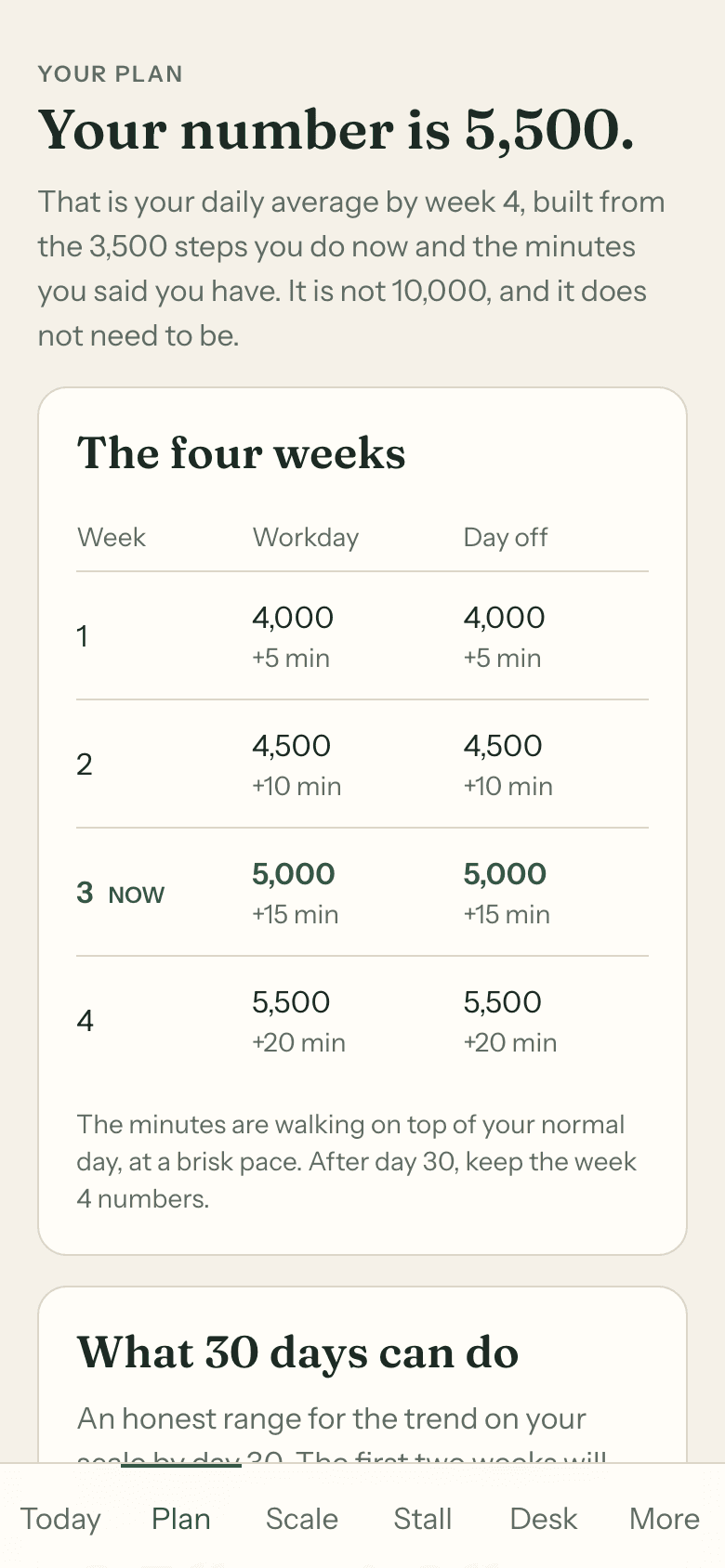
Two minutes of questions: your height, your weight, the steps you do now, the minutes you have on a workday and on a day off. You get a daily number and a four-week ramp to reach it. If you only have 20 minutes, the plan is built for 20 minutes.
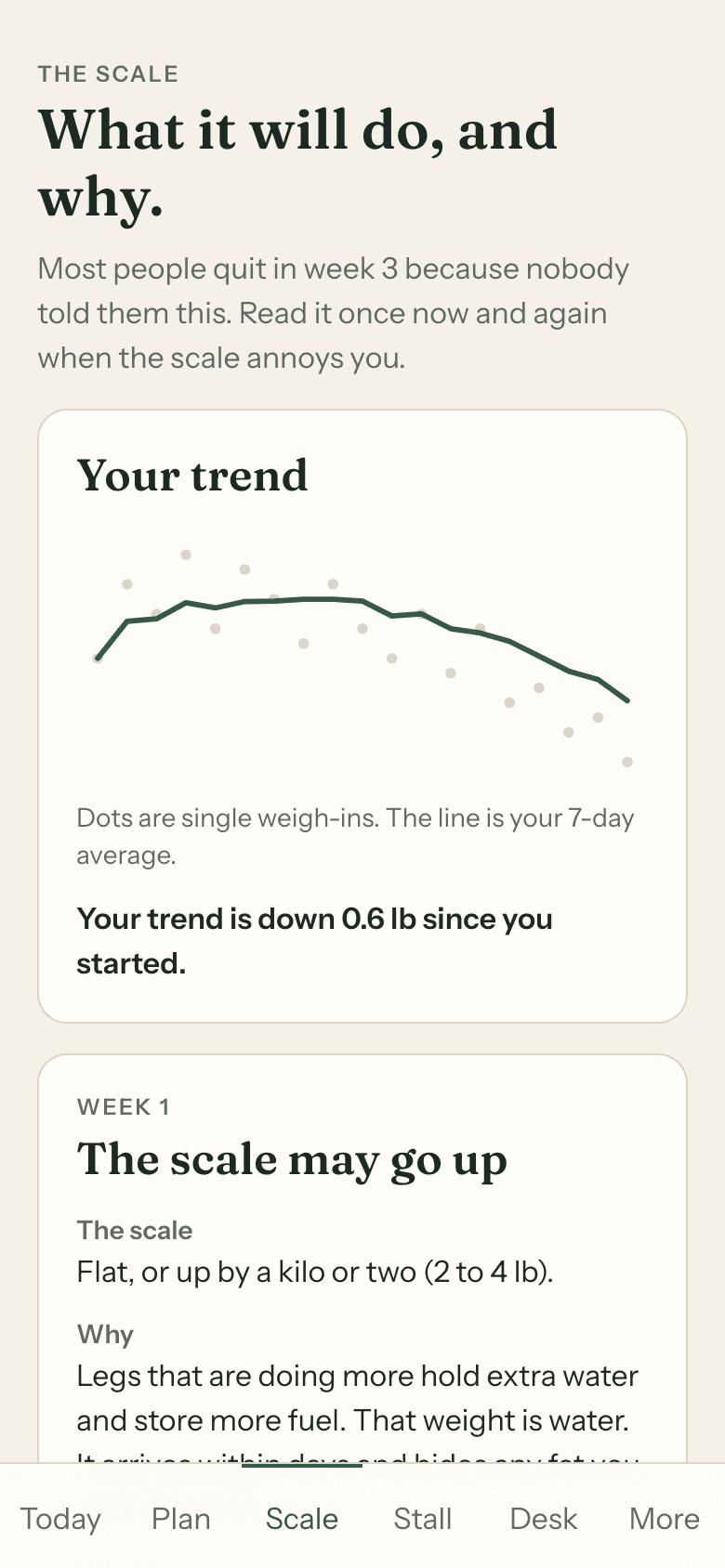
The scale, week by week
What the scale usually does in week 1, 2, 3 and 4, and why. Log your morning weight and the tool draws the 7-day average through the noise, so one bad morning stops deciding your mood.
A tracker that forgives
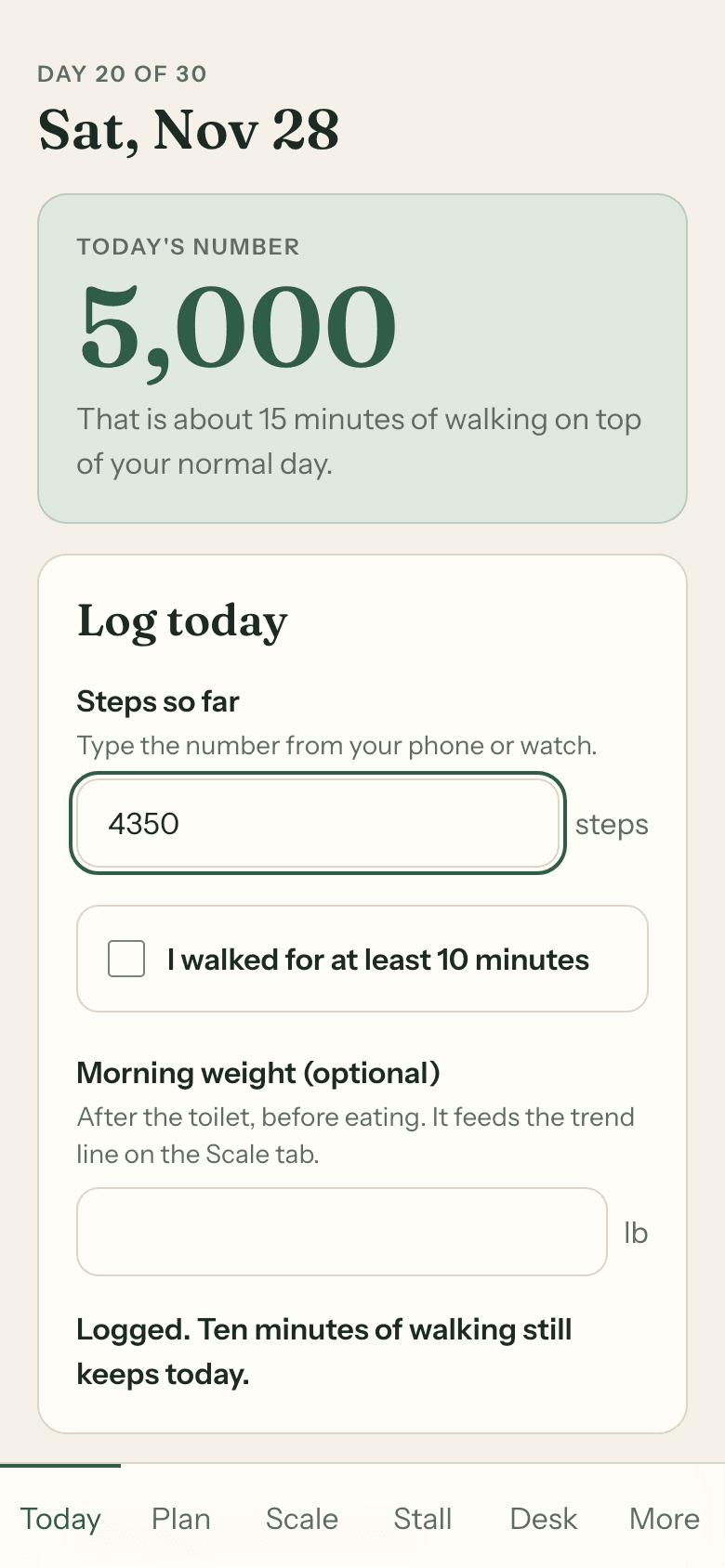
Type your steps. No watch, no sync, no account. A ten-minute walk keeps the day, and one miss a week is free. A streak that resets to zero after one bad Tuesday teaches you to quit.
The stall checker
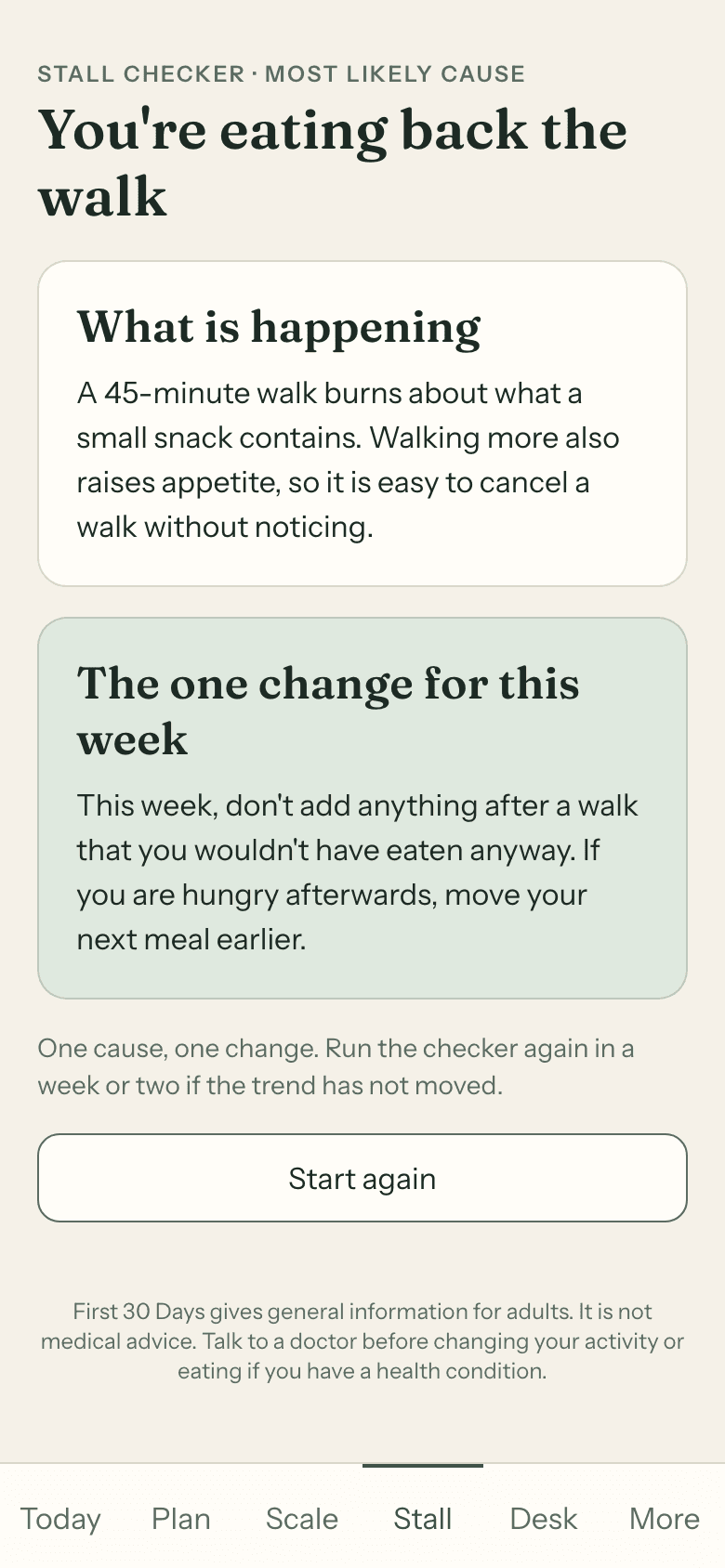
When the trend stops, answer 12 questions. You get the single most likely cause and one change to make this week. Not a list of nine things to fix at once.
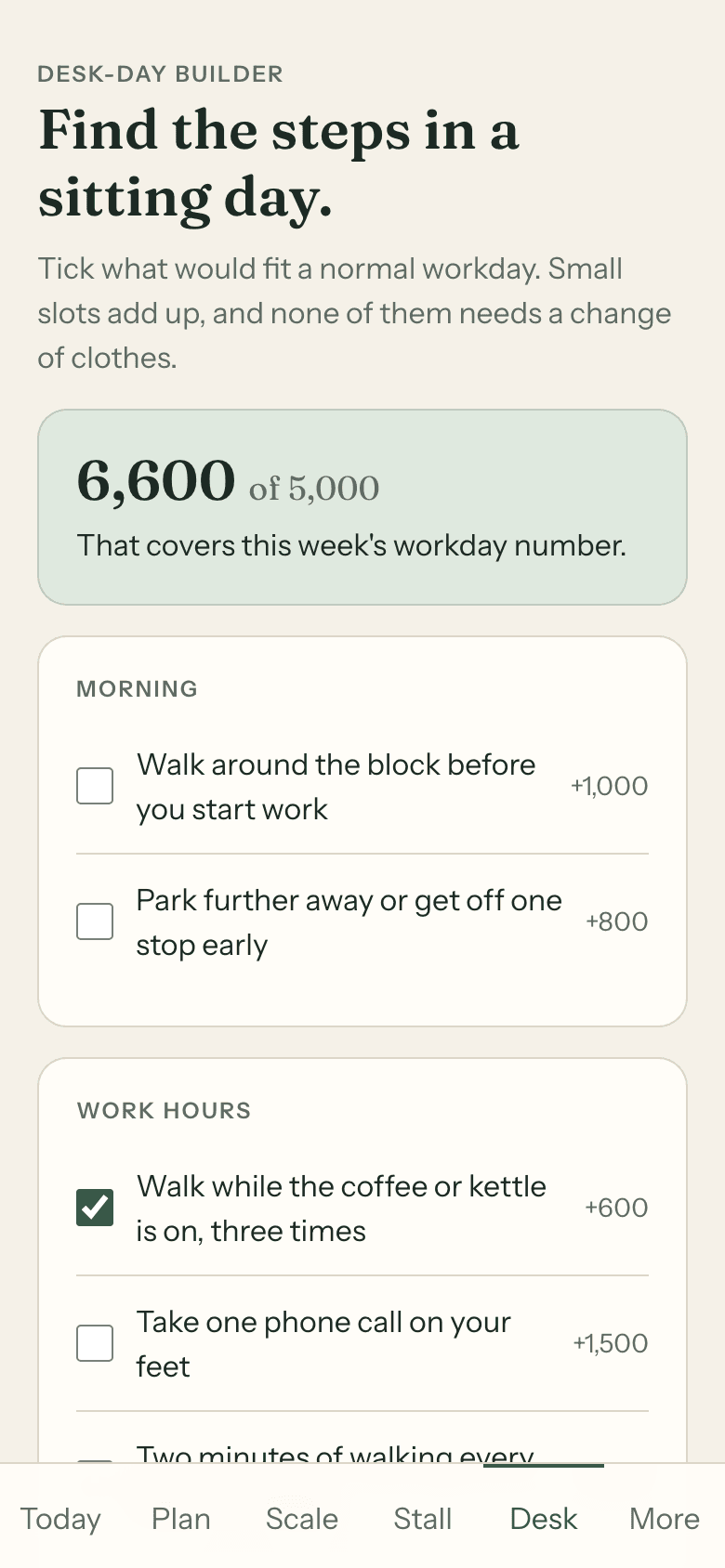
The desk-day builder
Tick the slots that fit a sitting day: the kettle, one phone call on your feet, ten minutes after dinner. Watch them add up to your number without a change of clothes.
Pay once, and keep it.
Walking apps are sold as a cheap trial that turns into a renewal. Then the app counts your steps, which your phone already did for free.
| Subscription walking apps | First 30 Days | |
|---|---|---|
| Price | A trial, then a renewal you forgot about | One payment |
| Your plan | A quiz, then the same plan as everyone | Built from your steps and your minutes |
| Tracking | A sync that breaks | You type one number |
| A missed day | The streak resets to zero | One free miss every week |
| When the scale stalls | Nothing | 12 questions, one cause, one change |
| Your data | An account and your email | Stays in your browser |
Why I built it
I tried running first. Walking turned out to be far more sustainable, and the reason is mechanical: running needs willpower every single time, and walking needs almost none. You don't have to talk yourself into it.
I lost fat walking. I also noticed something that has nothing to do with fat. After a 10 km walk it's impossible to feel bad. (I have tried.)
What nobody hands you at the start is the manual. How much is enough for your body, what the scale will do in the first month, and what to change when it stops. I build software, so I built that manual as a tool. It asks a few questions, does the arithmetic from published formulas, and shows you the sources.
You won't find before and after photos on this page. I can't promise you a number, and I would rather sell you something honest for $27 than something exciting for a monthly fee.
Sovithia
This is not for everyone.
- If you want a meal plan or recipes, this is not that.
- If you already walk 12,000 steps a day, more steps is not what you are missing.
- If you want to hear that walking melts fat by itself, I can't tell you that.
- It fits you if you chose walking because it is the one thing you can keep doing, and you want to know what to expect.
First 30 Days
$27
once
- Your step number and a four-week plan
- The scale timeline and your trend line
- The tracker with one free miss a week
- The stall checker
- The desk-day builder
- Yours to keep, with no end date
Checkout is not connected yet.
If it isn't useful, email me within 30 days and I refund you.
Questions
Is this an app?
It is a web tool. It opens in the browser on your phone and you can add it to your home screen. Nothing to install and no account to create.
How much weight will I lose?
I won't promise a number, and you should be suspicious of anyone who does. After setup the tool shows a range for your own numbers, split into what the walking does and what the eating does. For most people the walking part is small. Eating does most of the work, and walking is what makes it sustainable.
Do I have to count calories?
No. You pick one of three options at the start: change nothing, a small change, or a real change. If the scale stalls, the checker may ask you to write down what you eat for three days, once.
Do I need a watch or a step counter?
Your phone already counts steps. You read the number and type it in. That takes ten seconds and it never breaks.
Is it really one payment?
Yes. $27 once. No trial, no renewal, nothing to cancel.
What happens after day 30?
You keep the week 4 numbers and the tool keeps working. The tracker, the trend line and the stall checker have no end date.
Where does my data go?
Nowhere. Your answers and your weigh-ins stay in your browser. There is a backup code if you change phones.
I have sore knees, or a lot of weight to lose. Is this for me?
There is a gentle setting that adds steps more slowly. The tool gives general information for adults and is not medical advice. If you have a health condition, talk to a doctor first.
What if it isn't useful to me?
Email me within 30 days and I refund you. You don't have to explain.